


A year ago, I was finding myself getting irritated regularly on workplace social media pages.
Usually, the only time I bothered to comment was when I wanted to disagree with someone…
I rarely ever shared anything of my own in fear of being criticized as well…
But I wanted to share.
I didn’t want to leave social media completely (nor can you really as an online ESL teacher without missing out on important updates!), but I started to wonder:
Why am I getting into online arguments with people when I am normally a lot friendlier?
What’s making me feel stressed about work social media when I’m still getting a lot of useful information?
It turns out, I wasn’t spending enough time in the right “spaces” for me.
Also, I was getting way more stress than value in my social media use.
Now, I am immensely happier, positive, and productive due to finding spaces and boundaries that work well for me.
Read on to find out how you can too!
Printable Freebie
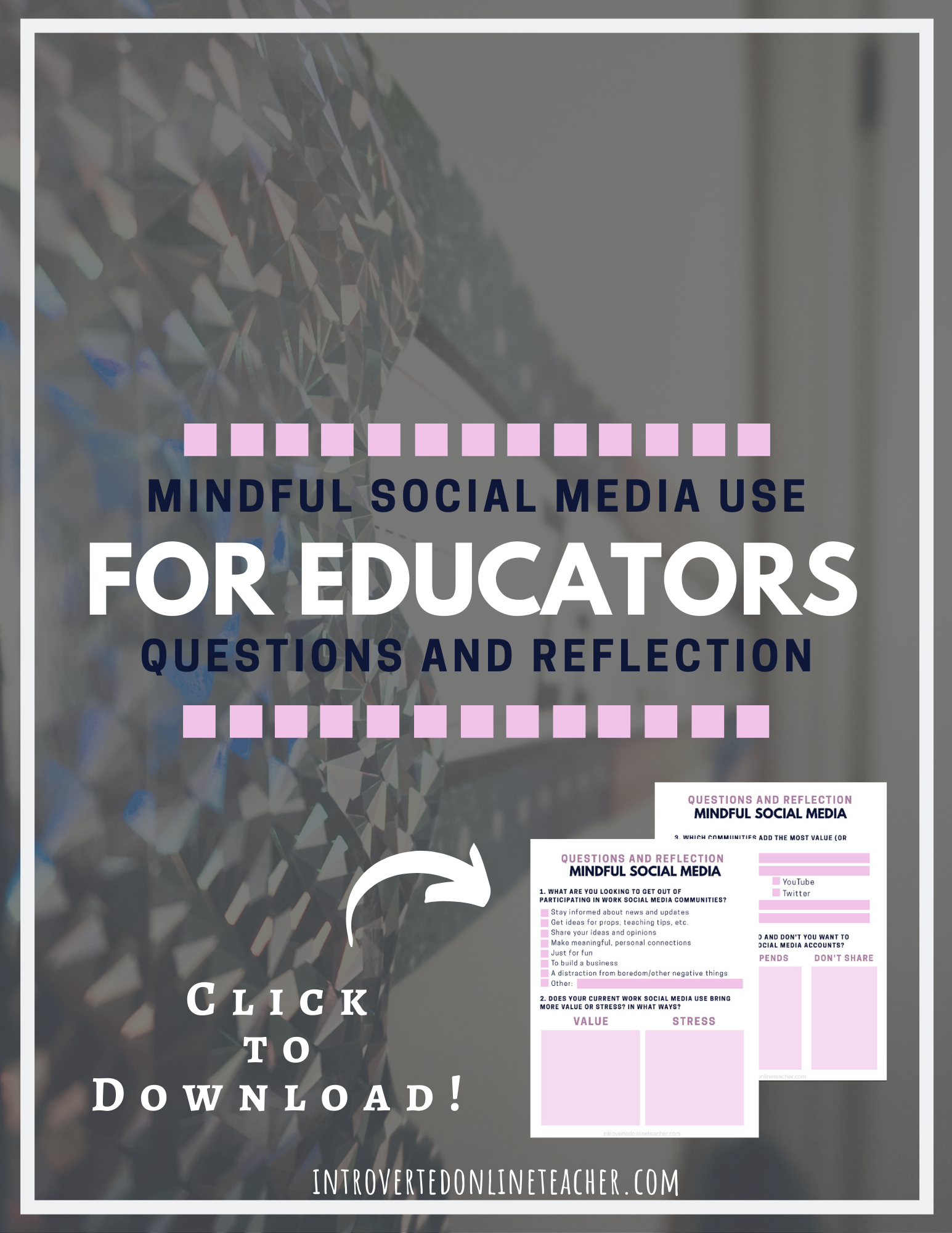
To accompany this post, here’s a Mindful Social Media Freebie you can fill in the responses to on the PDF and/or print out and fill in your answers!


This post is part of a 4-part series on Mindful Social Media:

Subscribe to stay updated on the next two parts, side hustles for teachers, and more!
Intro

Love it, hate it, or somewhere in between, social media is an integral part of many of our work communities, as well as the global landscape.
Social media platforms are used by one-in-three people in the world, with a number of sites to choose from every year.
Despite the potential negative effects of social media use, there are also a number of benefits, especially when looking to start a business, sell services/products, connect with other educators in your field, or just to share and express yourself.
Particularly for online teachers, where the nature of our work is virtual and without in-person “coworkers”, we are especially prone to seeking out community online.
Value vs. Stress
Social media is a tool that can be used to add value to your life rather than hurt your mental well-being. The key to finding the right balance for you is to self-reflect and establishing your personal boundaries.
Figuring out boundaries, in general, can be tricky, so here are some tips on deciding on social media and personal disclosure boundaries for yourself.
How do you find a “space” for yourself online and establish personal social media boundaries that work for you?
How do you make social media valuable for you as an online teacher or educator?
This post will cover reflecting on boundaries for where and how you interact with work communities, but not how often. I’ll include a resource at the bottom for setting time limits, as well as other resources from other teachers about this topic.
Question 1
Some of the most common reasons for educators are:
- To build connections
- To build a business/financial profit
- For self-expression
- To learn from other people
- Just out of habit
- A distraction from boredom/other negative things
etc…


Your specific motivations as your answers will determine which spaces are ideal for you. Some platforms tend to be more or less critical to sales, personal disclosure, controversial opinions, etc. (which I will cover more under question 3).
Question 2

Depending on the time in your life, personal circumstances, mental health status, etc., it’s important to reevaluate regularly and see if your work social media usage is bringing more:
- happiness
- stress
- value
- some combination of the above
- or it’s just a neutral part of your life
I asked this question on Instagram and got these (non-scientific) results:


It is important to be honest with yourself – there’s NO right or wrong answer.
Stress From Engagement
If stress is coming from changes in engagement (likes, comments, income fluctuations, etc.), here’s something I learned that opened my eyes:
Most social media platforms are designed to get you hooked at first, then gradually decrease organic reach so that you have to spend more time or “pay to play” to get similar results.
When an educator’s business/brand is tied to companies that can easily manipulate how many people in their audience even see their posts…
It’s easy to get stressed out about radical changes in results even if you’re doing all of the same things.
A similar principle can apply for us online ESL teachers, as we are at the mercy of whichever company or companies we work for. Also, we rarely find out what actually goes on behind the scenes in terms of changes and decision making that is not always for the benefit of us teachers.
In either case, it becomes even more important to have a community of other people in your niche that want to help each other out and share opportunities.
I found out about teaching ESL online with VIPKid and a number of other opportunities through Instagram and Facebook groups, so I have social media to thank for my job!
Stress From Social Comparison
It’s no secret that social media can magnify the impact of social comparison. Depending on your age, personality, life situation, etc., certain social media platforms or groups may cause you to feel inadequate rather than inspired.
If that’s the case, you can either change your settings to see less information from that person/group, look into mental activities that help boost self-esteem, or just avoid that trigger altogether as much as possible.
Stress From Group Dynamics
Sometimes, the stress is coming from the culture of the community you’re in. The culture can depend on the platform, the size of the community, and a number of other factors, leading to…
Question 3
With a number of social media platforms available to correspond about online teaching (or whatever your interest/niche is), how can you decide which space is right for you?
You can assess the culture of a group by reading through the posts and comments to see the common tone and mood, especially ones that gain a lot of traction.
Why is which group or platform(s) you’re in important?
One big reason is that the group(s) you’re in have the power to shape your perspectives on situations. The huge degree of influence is due to a variety of psychological principles, including group polarization:
“Group polarization occurs when discussion leads a group to adopt attitudes or actions that are more extreme than the initial attitudes or actions of the individual group members.”
This effect can happen even when people are not physically together, so it’s important to keep in mind:
- Is this group and/or community shaping my views to be more:
- Positive?
- Motivated?
- Discouraged?
- Critical?
There should be a healthy balance that works well for you and doesn’t cause undue stress.
At the same time, it shouldn’t keep you in the dark from real events and challenges occurring in your field of work.
What are some recommended spaces?
If you’re a VIPKid teacher, Teacher Amelia wrote a post about different VIPKid groups.
For me, as an online ESL teacher, previous B&M teacher, and “edupreneur” looking to:
- build a brand
- make meaningful connections with like-minded educators
- learn from others
- share my thoughts, talents, products, etc.
I personally have found the most value from:
- Instagram
- Particularly for the online ESL community, teachers are refreshingly supportive but honest
- Sales and self-promotion are fully welcome!
- Specific Facebook groups, such as:
My downloadable freebie has some other suggestions as well!
What if I can’t find something that works for me?
If there’s one thing I’ve learned being on so many different social media platforms for work, it’s that there are like-minded people in your job out there.
Consider making your own group!
Depending on what your interests are, you can make your own group for your specific company, subject area, etc. Even if it starts out tiny, the possibilities are endless for different niches and ways to bring people together online.
Question 4
Whenever I think about what to post, where to post it, etc., I try to remember:
Once something’s on the Internet, it’s there for good.
Whatever group I’m posting in, I expect it to be seen by everyone and maybe even people outside of the group.
When I started an Instagram page, I decided not to show my face until I felt comfortable enough to do so.
Also, nowadays (not so much in the past), I wait and read carefully before I post to make sure it isn’t too personal, too harsh, etc.
Some things you may or may not want to share:
- Your picture/full name
- Personal, private information, such as information about your family
- Any specific personal beliefs/opinions
- The amount of money you make
- Any posts that you might regret in hindsight…
If you feel like you need to vent, I sometimes write it in an email draft or notepad. Having it written somewhere separate allows me the opportunity to get my thoughts down without having to post it right away.
Conclusion

Once I found my “spaces” and communities that worked best for me, as well as my personal disclosure boundaries, spending time on social media added way more value than stress.
The positivity and ambition of people on Instagram and the groups I mentioned above also impacted my perspective of being an educator, and I am a more pleasant person overall now.
I didn’t completely leave every other space that previously brought me stress, but I just spend a lot less time there and only keep an eye out for the most important updates.
Although that’s what worked for me, you may be looking for something different.
That’s okay!
What if I’m just overwhelmed right now in general?
Similar to stress from social comparison, sometimes cutting off a group or social media platform cold turkey is the best course of action.
It can be either for a few days, weeks, or whatever time you need to regroup or focus on other areas of your life.
Some weeks I post a lot, other weeks I don’t post at all, but overall…
Make social media work for you, NOT vice versa!
—————-
Subscribe for freebies and notifications on parts 3 and 4 of the series coming up in the next few weeks:
Part 3: How to make connections with and learning from other online teachers on Instagram and beyond
Part 4: Important tips and resources for your teaching Instagram (or other social media account) in 2020
If you missed it, check out Part 1: How and why I began an online teaching Instagram without showing my face (until now)
For further reading:
- Should I Have A Teacher Instagram Page? – Marilyn (another VIPKid teacher) discusses some easy steps to creating a teacher Instagram in a positive, mindful way.
- 5 Social Media Self-Care Tips – Amber from Learn Grow Blossom shares some practical and uplifting tips to balance social media use with self care.
- Dear First Year Kindergarten Teacher, I’ve Got You! – Amanda from Sparking in Primary outines tips for first-year Kindergarten teachers with a free downloadable routine checklist workbook.
- 5 Ways to Cut Back On Social Media – pcmag.com
Sincerely,


The Introverted Online Teacher