


Working in education has been described as a profession that is “emotionally taxing and potentially frustrating” – a description that can extend to both classroom and online teaching.
Teaching online can take many shapes and forms depending on your company, district, and/or content area. Whatever your particular situation, it’s just as critical for teachers to practice self-care even if they aren’t physically teaching in the classroom.
Some online teachers now also have the particular challenge of balancing working, parenting, and teaching from home. As of April 16th, half of all schools are closed for the rest of the year, with no concrete end in sight as we work to reduce the spread of COVID-19.
Whether you’re a seasoned online teacher or thrust into this new role unexpectedly, it’s important to take small, practical steps to reduce some of your stress and create support systems for whatever lies ahead.
As many tips at once can be too much to take in at once while stressed, check below to see where you want to start if you can only manage one area for now!
Disclaimer
While these tips have personally helped me and I’ve included some studies and research, I am not a professional in any field of mental or physical health. Please do your own due diligence and consider your individual circumstances.
This article is best suited for teachers dealing with mild to moderate stress primarily related to organization, boundary setting, etc.
If you are experiencing significant and/or debilitating stress or are in need of professional mental health support, please check out these free resources.
Subscribe for updates on new posts about teacher side hustles, self-care strategies, freebies, and more!
Jump ahead to:
7 Stress Relievers For Online Teachers

Self-Reflect: Which Areas Bring you the Most Stress?
Physical Space: Adjusting Your Workspace
One advantage of teaching at home is that you usually have more control over who comes into your classroom and the condition it’s kept in.
(The impacts of your family, however, is another story).
Increased clutter has been found to be associated with more stress, including findings by Princeton that:
“…constant visual reminders of disorganization drain our cognitive resources and reduce our ability to focus.”
While trying to aim for complete order is often too overwhelming when we’re already stressed out, the key is that:
Even a little more organization can help increase your productivity and reduce your stress levels.
Some things you may already have around the house that can help:
- Cardboard boxes
- File cabinet
- Makeup organizer
- Over-the-door shoe holder
I personally had a lot of flashcards and props that were hard to sort through while teaching ESL online, so I got this shoe holder!

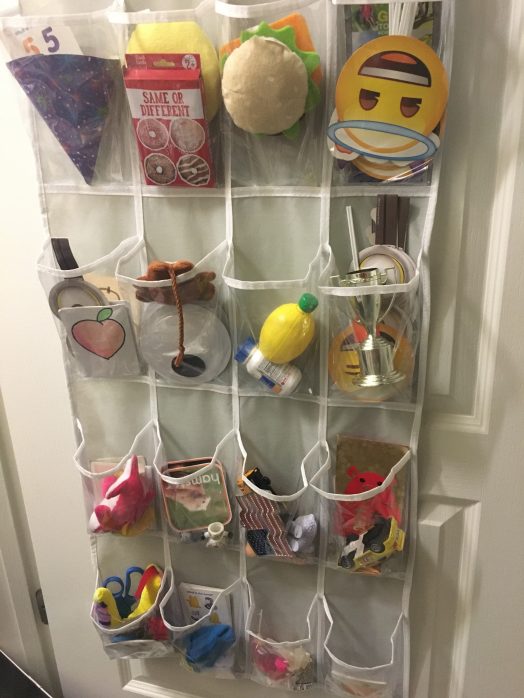
Having some sense of organization has reduced some stress while teaching. Also, there is less visual clutter in front of me, allowing myself to better focus on teaching and other work tasks.
Relaxation: Box Breathing Technique


With long stretches of teaching online and/or working in front of a computer, it can be easy to start feeling stressed without allowing time for our body to take in air properly.
I learned about this breathing strategy in a counseling strategy, which helps improve concentration and performance while also reducing stress.
4 Steps:
Prior to starting: Slowly exhale through your mouth
Step 1: Slowly inhale through your nose for 4 seconds
Step 2: Hold your breath for 4 seconds
Step 3: Slowly exhale again through your mouth for 4 seconds
Step 4: Hold your breath again for 4 seconds
Self-Care: Create a “Self-Care Toolkit”
This idea came from these 25 Mental Health Wellness Tools from a New York psychologist (a great article to check out in its entirety!).
“A lot of successful self-care strategies involve a sensory component (seven senses: touch, taste, sight, hearing, smell, vestibular (movement) and proprioceptive (comforting pressure)”
Here are some suggestions for some of the senses for online teachers:
- Touch – A small blanket, robe, PJ pants, etc.
- Taste – A warm drink or snack, minty gum
- Sight – Some pictures of family, inspirational quotes in your classroom background
- Hearing – Soothing music, white noise, etc.
- Smell – A pleasant candle or air freshener in your online classroom
- Proprioceptive – A comfortable chair
My self-care toolkit includes comfortable PJ pants and a jacket I use to work, a comfortable chair, tea and honey, and bright, colorful props in my classroom.


I also have a plan for getting sick as an online teacher so that I’m less likely to be caught off guard and overwhelmed.
Online Organization: Systems to Save Time and Mental Energy
A lot of online educational work involves repetitive emails, feedback, virtual forms, etc. that can easily become more time-consuming than it needs to be.
If you find yourself getting frustrated with doing the same things over and over again or using systems that are not working efficiently, here are some programs I recommend:
Organization
- Google Keep
- If you need a place to create checklists, Google Keep allows you to organize teaching and non-teaching info.
- Specific lists can be easily shared with other people
- If you need a place to create checklists, Google Keep allows you to organize teaching and non-teaching info.


- Google Docs
- If you’re an online teacher and need a way to refer to feedback, notes, etc. easily, one way to do so if by having a Google Docs sheet open next to your tab
- Note: Use at your own discretion as you don’t want to get a ‘darting eye’ look while teaching! Some teachers may just keep it there to refer to between classes, etc.
- If you’re an online teacher and need a way to refer to feedback, notes, etc. easily, one way to do so if by having a Google Docs sheet open next to your tab
Emails/Feedback
- Text Blaze (Google Chrome Extension)
- If you find yourself typing similar sentences over time, you can use this shortcut tool ($7/year for educators) that lets you add sentences that you can easily add in your writing!
- For example, when I type /class, the sentence: “In class today, we practiced the following words and sentences: ” pops up, allowing me to save a lot of time in the long run by using shortcuts when typing!


- Feedback Panda
- Many online ESL teachers have either heard of or use Feedback Panda, but if you haven’t, it’s worth checking out! Feedback Panda has 1,000’s of prewritten, customizable feedback templates that save me time every day when submitting student feedback.
Community: Where to Find Virtual Teacher Groups
For years now, us online ESL teachers have had to rely on online teacher groups for information, resources, and just to connect to other online teachers.
Even if you’re not a big social media person, now is a wonderful time to find some teacher communities online. The right groups can provide a ton of support and value to you and your work as an educator at home.
Here are some of my favorite groups/spaces:
- Virtual Learning Party for Teacherpreneurs!
- Hired Online ESL Teachers with Job Reviews
- TPT Seller Tips and Advice
- Self Care for Introverted Teachers and Teacherpreneurs
- Instagram Connection for Educators
- Teacher Blogger Collaboration
- VIPKid Mental Health and Wellness (for VIPKid teachers) or
- Mental Health and Wellness (for anyone)
- The #onlineteachers Instagram community
Now more than ever, finding like-minded educators online can be the difference between sinking or swimming with the changing online education landscape!
However, if some groups, accounts, etc. are currently causing you more stress than happiness to follow, you can ‘mute’ their posts on Instagram, Facebook, etc. without having to completely unfollow them.
I do this sometimes when I’m just not ready to keep seeing information (such as the group I’m in for Outschool) but want to have it available once I have the time and mental energy to participate!
Boundaries: Define and Communicate Your Work Boundaries
One benefit and struggle of working from home as an educator is that you usually have more autonomy over your time and schedule.
Depending on your particular situation, you may still have predetermined work hours or you may choose your work schedule.
Either way, setting your own work boundaries and reflecting regularly on whether they’re working for you or not financially, emotionally, physically, etc. is crucial!
Here are some questions to start with:
- How many hours do I want or need to work?
- How much time each day or week do I want to devote to spending time with family, personal hobbies, and other responsibilities or interests?
- What do I need while I’m working? such as a quiet space, no interruptions, going to bed by a certain time, etc.
- When I’m working at home, how will chores, watching kids, and other responsibilities be distributed?
Try writing your answers to these questions down on a piece of paper to hold yourself and (if applicable) your family accountable.
Transitioning to at-home work, having kids at home all the time, and other life changes can certainly be rocky. However, defining and refining boundaries as needed can help everyone be on the same page and work together under one roof.
Productivity: Tiny Behaviors Over Goals
When I’m feeling especially stressed, large goals seem overly daunting and overwhelming.
Fortunately, research supports focusing on small habits over goals is a way to create significant change over time!
For example:
I used to say “I will post 2 blog posts this month” and ended up getting discouraged when half of the month went by and I didn’t even have one finished.
At that point, I’d think “Why even bother then with the rest of the month?”
I’m already too far from meeting my goal.
Now, I say “I will write for at least 15 minutes each day” (or sometimes even just 5 minutes if that’s all I can muster). This way, even I fail a day or two, it’s a lot easier and less stress-inducing to try again the next day!

When you’re stressed but want to still be productive, tiny behaviors every day (or every other day) feel a lot less daunting but are still meaningful.
What tips do you have to relieve stress as an online teacher?
Related Resources
- Subscribe here for online teaching tips, resources, and posts related to mindfulness!
- Want to know more about teaching ESL online with VIPKid, GoGokid, or other companies? Check out my FAQ on VIPKid and Outschool. If you’re not sure where to begin, email me at introvertedonlineteacher@gmail.com for FREE resources and guidance.
- Interested in mindful and valuable social media use? Check out my first post in the 4-part series, which also shares a little more about me and why I started this blog/a teacher Instagram.
Sincerely,


The Introverted Online Teacher


